
Les Clans
Le Bourg

The gateway to the wonderful medieval world is the Bourg de Saint-Marcellin. This immersive experience will welcome you with medieval music while you can add an extra layer to your visit by dressing in period costumes at the Ladies’ Room (costume rental). After dressing up in your finery, you can take the time to lighten your purse by visiting our artisans and Merchants. Afterwards, you can stuff your belly at the Cochon d’Or (catering) where our innkeepers will serve you tasty and inexpensive grub. If you are just a little hungry, you can treat yourself to some sweet treats at Douceurs de Marianne (convenience store). To quench your thirst during your visit, you can visit the bar where they can offer you beers, mead and wine…you can even get water there. Do you need to rest? Take the time to sit in Sire Rolland’s house where you might see passing troubadours.
Be careful when night falls! You could come up against dragons (fire-breathers) who will prove to you that they are not ferocious, but that they are impressive and fascinating, despite the heat that their flames give off.
Finally, the Village offers you the opportunity to discover the largest trebuchet in
North America which will be in action a few times during your stay with us. You can have an unrivaled view of the shots by sitting on the mound at the foot of the tower, and only if you are among the lucky ones who arrived early enough to have this prime spot.
Continue your journey past the trebuchet to discover the different clans who will offer you unforgettable experiences.
Royalty

King since the very beginnings of the medieval Feste, Pierre Kotte the First reigned over the Bourg de Saint-Marcellin. A widower for ten years, he received a very special offering from the Mamluks. Princess Isabeau Du Lac. To seal peace with the kingdom, the clan of warriors gave her hand to the king. With dignity, she had accepted her destiny, that of arranged marriages which only suit others. But her charm and her melodious laughter melted the king’s heart. This severe man, once so serious, who was said to have never smiled, regained a taste for life, and even became… Quite festive!
Banquets multiplied in the kingdom of Saint-Marcellin, but not all had such joyful hearts, including the Company of Saint-Adrien. A quarrel broke out between the King and Jolicoeur, commander of the Burgundy mercenaries, and the latter’s sword was lodged in the monarch’s bowels. Despite the efforts of Celtic healers and the Templars, Pierre Kotte Premier succumbed to his wounds. Queen Isabeau Du Lac, strong in the oath of allegiance of Sir Alexandre de Saint-Georges, representing the knights of the crown, now finds herself alone to reign over the kingdom.
Commandery of the Templars of Saint-Marcellin

Good day to you.
We are the Templars of the small commandery of Saint Marcellin. Our first role being the protection of royalty, against lands. What we offer to the party are their stories of nearly 200 years of domination in Christendom.
-Foundation of the Templars
-Great battles
-Special menus of the Templars
-Fall of the Templars, the curse
-The gold of the Templars!!!
Our Credo: Non Nobis Domine, Non Nobis Sed Nomini Tuo Da Gloriam
Quebec Medieval AssociationThe Knights of Saint-Marcellin

25 years of thrills, 25 years of emotions, 25 years of passion!
The Medieval Association of Quebec (AMQ) is a historical representation group of the second part of the 15th century, towards the end of the Middle Ages. The many members want you to experience an immersion in the past, during knights’ tournaments or by evoking daily life. The AMQ is, first and foremost, a team, a united group of passionate people whose goal is to turn the big wheel that represents it.
Follow us, and let yourself be guided on a journey to the past… Whether in the stables where you will see the grooms at work; under the knights’ tent where the squires go about their business; in the various artisan stalls where you can observe historical techniques; in the kitchens where histocompatible food is in the spotlight or at the inn, our camp, you will immerse yourself in a world of unsuspected discoveries. The knights will make you experience all kinds of emotions with their armor just as shiny as their muscles. Representations of sword or halberd fights will leave you speechless. You will also be able to admire the agility and precision of our riders during equestrian games such as penon, headcutting or quintain. Come and cheer on your favorite knight during the jousts where you will see lances shattering as you cheer. Be comfortable shouting very loudly, the knights have difficulty hearing under their armor! In the evening, the members of the AMQ invite you to a magical moment where fire eaters and jugglers come together to offer you a fiery show. You will be amazed by everyone’s prowess.
When you come to see us, don’t hesitate to ask one of our knights for an autograph; to bow low to the noble Ladies; to ask our acrobat for a little pirouette or to discuss a recipe with our master chef… Each member can’t wait to share a bit of their passion with you.
The Forest Celts

As a privileged visitor, you will have the chance to take a trip back in time and meet the great family of the Forest Celts
Our primary goal is to entertain you and introduce you to the habits and customs of the Celtic peoples as well as to immerse you in the daily life of a small Celtic village in a context of everyday activities. The period covered is from approximately 200 BC to approximately 50 AD.
Through different activities, you will be able to learn the origin of the Celtic people, the way they lived and ate in addition to the trades they practiced, how they entertained themselves as well as the way they prepared for war. Moreover ! You might have the chance to participate in games alongside us!
Other aspects covered during your visit to us will be: how the Celts were able to live for around 800 years without the knowledge of writing and of Celtic history through the discovery of major archaeological sites and the people they encountered.
Come see us work and interact with us.
Our old storyteller will surely teach you something new.
The company Saint-Adrien

The company reproduces an orderly company from the end of the Middle Ages. As Saint-Adrien de Nicodème is the patron saint of soldiers, the founders chose him to name the company. This military troop allows you to relive the Burgundy Wars, attempting to represent the era of Charles the Bold as faithfully as possible.
The Burgundy Wars (1474-1477) mark a turning point in the history of Europe. This duchy was then on the way to becoming an independent kingdom of the French crown. In order to achieve victory, Charles the Bold established a new military system: the ordinance company. This organization aims to have a permanent paid army. It is by basing themselves on the writings of the time that the members of the Saint Adrien company succeed in representing the military life of this period.
The members of the Cie de Saint-Adrien have adopted a red Saint Andrew’s cross as their emblem and respond to the cries: “For the good Duke! Burgundy! » Their weapons are those of the end of the Middle Ages: pikes, vouges, swords, but also the new weapons using gunpowder which the Burgundian army used.
The company of Saint Adrien sets up camp on the lands of Saint Marcellin awaiting the next confrontation. During the festival you can see them in action in their military exercises. You will also be able to discover the reality of a 15th century soldiers’ camp: the kitchens, artisans and families following the troop from camp to camp and expose another reality of this era.
The Mamluks

Forgotten by Western history, the Mamluks were nevertheless the masters of the Holy Land from the middle of the 13th century (1250) until the beginning of the 16th century (1517).
Their rise began in Egypt at the end of the 11th century where they formed a formidable mercenary army, made up of slaves converted into loyal, non-religious elite soldiers paid in money, food and promotions within the Mamluk army. The Mamluk recruited slaves by force, but especially through trade with neighboring Turkish, African and European countries. The funds paid over several generations by Muslim sultans, who competed in turn for the services of these elite troops to settle their personal conflicts, allowed the Mamluk army to establish itself as an essential military power against the invasions of the Crusaders in the Holy Land from the end of the 12th century (1189).
In the middle of the 13th century (1250), the inaction of the last Ayyubid sultan, paralyzed by his agreements with the Crusader invaders, motivated the Mamluk general Baibars the Archer to seize power through a bloody coup d’état. From then on, the Mamluk army financed itself from generous profits from the trade of the silk and spice routes. Consequently, the crossed strongholds successively fell into the hands of the valiant Mamluks. In 1291, it was the end of the crusader positions in the Holy Land when St-Jean-d’Acre was taken by the Mamluk. Finished was the Kingdom of Jerusalem to the great misfortune of the religious Orders of the Hospitallers and the Templars!
Another major historical feat of arms, the Mamluk inflicted, in 1260 at Aïn Djalout, the first defeat of the Mongol hordes since the start of their conquest towards the West which began in 1203, which saved Egypt and Islam and put an end to the Mongol advance towards Europe.
The 14th century was a prosperous period for the Mamluk Empire which then included the vast crescent of the Mediterranean basin formed from eastern Turkey to Libya in Africa, the best-known cities of which were Damascus, Acre, Cairo and Jerusalem. The Mamluk Empire then converted to Islam and produced two dynasties which were overthrown in 1517 by the Ottomans. The Mamluk Sultanate will survive in Egypt within the Ottoman Empire.
So come and meet the Mamluk clan, you will be amazed by their little-known history!
Icelandic Vegvisir clan

Made up of thematic Microsites linked by a path, the Icelandic clan named Vegvisir will welcome you with happiness. Made up of artisans and historical, political and cultural interpreters, this visit to the year 1000 will charm you.
The Vegvisir itself, a magical symbol with eight branches (known later), is representative of the subjects covered by our interpreters. The precariousness of resources as well as several techniques and tools known during the colonizations from Iceland to America between the years 874 and 1120 are well known by our members. We will do demonstrations, workshops and you will be able to discover the exhibition of work from the raw materials to the finished products.
Driven by the desire to share our research and experiments, the members of Vegvisir draw inspiration from texts taken from historical documents (such as the “Icelandic Sagas” or the “Landnámabók”, the work of historians such as Régis Boyer (Medieval Iceland) and archaeological finds). During your visit you will see several themes interpreted such as the textile trades and its different techniques depending on the methods and uses. You will see, among other things, knitting, dyeing, tablet weaving, but especially vertical loom weaving to explain “vađmál”. Directly linked to the economy, this woolen fabric is regulated to ensure its quality. Raising sheep from which wool is obtained is therefore essential, because with fishing, they are the main resources and currencies of trade.
The camp will allow you to enjoy daily activities through habits and customs. You can join in conversations about Norse mythology and the introduction of Christianity or even hear about the little people and cultural legends still present more than a thousand years later. Along the route, you will discover the making of modest homes that defy the elements. At mealtimes, menus are prepped and prepared with ingredients available on the island or imported.
Like the medieval Icelandic people, the members of the Vegvisir have a unique social policy and are organized into a society whose leader is only “The Law”. What better way to try to understand the mentality of this island people than by discussing the concept of “Ϸing”, the assembly of “Free Men”, who by definition have the right to speak and make decisions together in a common interest.
Finally, Vegvisir takes great and renewed pleasure in presenting the medieval Icelanders in an educational way and in constant interaction through the experimental archeology that defines them.
Scottish Camp - Clan Wallace
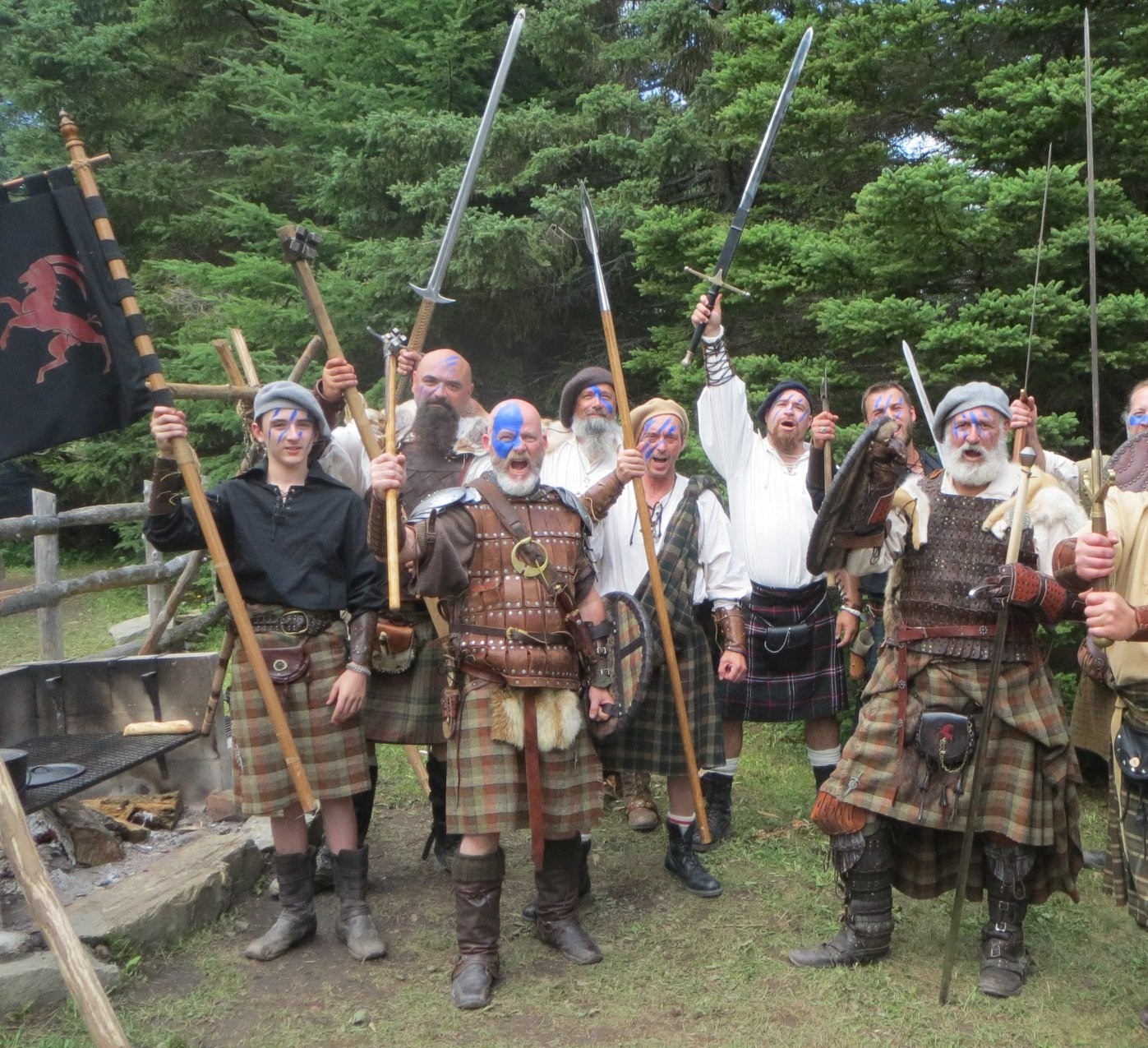
On the borders of the lands of the Bourg de St-Marcellin, far beyond the walls of the enclosure, lies the place called Stoneheaven, land where the much-feared Wallace clan resides.
This clan was founded by Richard of Oswestry, originally from Wales. The latter followed his lord to Scotland in or around 1067 and earned the nickname Richard Waleis (Richard the Welsh). The clan you will visit took this surname in honor of Scotland’s national hero, William Wallace, the “Braveheart” who was the spark of the Scottish resistance against the English invader.
At the Saint-Marcellin Medieval Fest, the clan reproduces the habits and customs of these peoples who lived north of the Adrian Wall in the early Middle Ages. The “sept” and families that make up the group, prefigure the caste system and popular traditions that would last until its peak in 1746, the date of the Battle of Culloden where the British regime dismantled this ancestral way of life.
At the camp, there is neither castle life nor rich costumes worn by the nobles. The clothing of rural populations in the Scottish countryside is simple and functional. As visitors, you will understand why we wear the fèileadh beag, the breacan fèild or the fèileadh mòr, the tartan, whose origins are lost in the mists of time. There you will find a reproduction of a typical village composed of a dry stone “Longhouse” with a turf roof “unique in Quebec”. Its halls with its bread oven, its functional forge, its gallows, its wooden houses, and more will amaze you. The artisanal products shop, the different scenes and the history of weapons through the centuries will be in the spotlight. Let’s not forget the Celtic atmosphere and Scottish music shows.
See you soon to live the Scottish experience at Stoneheaven. The Wallace Clan tells you Alba gù Brath!!
Ròtlönd
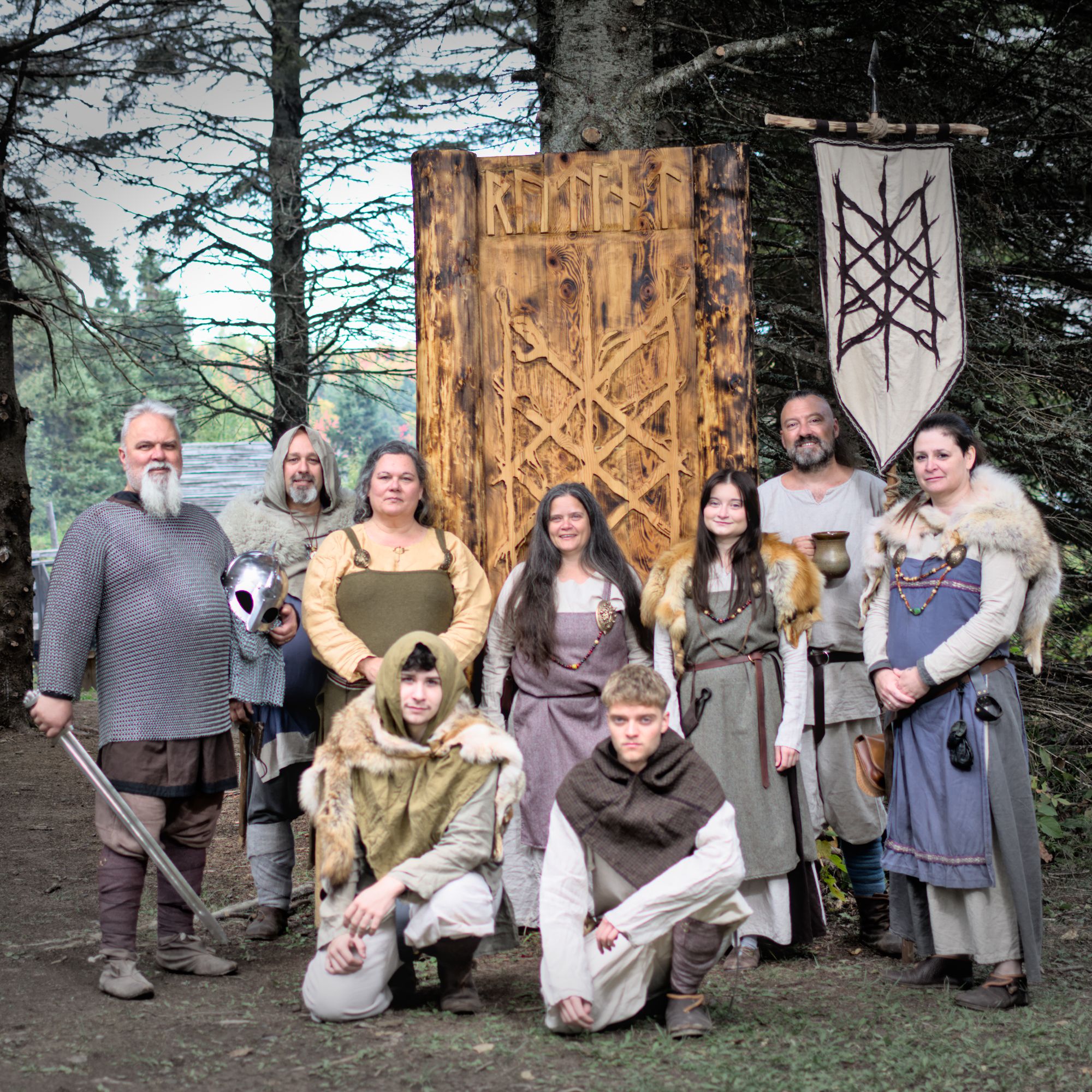
We are Clan Ròtlönd, a Norse reenactment group representing a community from Vestfold County in Norway between 850 and 900. As the county was a key region of Viking royal power at the time, you might even encounter King Harald I of Norway. The group focuses primarily on recreating artifacts and concentrates on the activities typical of this region during this period.
During your visit to our “Land of Roots,” you will be transported back in time through various workshops, from the trade that flourished in Kaupang, a major trading center in Norway, to the agriculture practiced by the majority of the population.
Each year, you can admire new reproductions of artifacts. Our collection includes an interpretation of a Gokstad bag, combs made of bone and antler, and other crafts discovered at various local archaeological sites.
Our emblem is the Wyrd Web, depicted as intertwined tree roots, a connection to the clan name meaning ‘Land of Roots.’ It also reminds us that all things in the universe are interconnected, and the web casts a matrix over our lives, believed to control the fate and destiny of each clan member.
Come and intertwine your destiny with ours by passing through our lands.
The Vikings - Krablag Troop

Located in the Saint-Marcellin forest, the Krablag military camp is easily identified by its orange and white colors. Krablag meaning “crab troop” is inspired by the snow crab of the St. Lawrence River.
The members of the troop will present to you a typical portrait of the raids and conquests of the life of Viking era fighters which took place between 950 and 1050 AD. Come and take advantage of this timeless moment to have the opportunity to see presentations of our daily lives. Built by the dedicated members of our troop, our camp focuses on the regions of Scandinavia, England, France and the Rus’’of kyiv, and are based on rigorous historical sources.
The members of the Krablag regularly train in steel blade combat to offer you diverse and real combat demonstrations, whether on the bridge leading to Mossurland (another Viking camp) or in the arenas and battlefields of the Festival.
During this annual event, the Krablag is happy to welcome different troops of Viking fighters from all over Quebec to make Saint-Marcellin an essential provincial meeting place for Viking reenactment.
Slava!!!
Camp viking - Clan du Mossurland

Welcome to the year 850. In these lands of Svealand, between Lake Mälar and the Baltic Sea, we, members of the Mossurland clan, bring to life the heritage of our Scandinavian ancestors. Mossurland, the “Land of Maples,” is our home, an echo of the vast forests of the North and our deep roots in the traditions of the past.
We are artisans, warriors and guardians of ancient beliefs. Proud heirs of the Svear, we prosper thanks to the flourishing trade with the Slavic, Baltic and Eastern peoples. Our clothes and our ornaments reflect this richness of exchanges, witnesses of the trade routes which cross our region and nourish our traditions. Where others embrace new beliefs, we remain loyal to the gods of Asgard. Our clan perpetuates ancestral rituals, honoring Odin, Thor, Frey and Freyja through ceremonies that punctuate our existence. The most sacred of them takes place on Saturday evening, a timeless moment when, in the light of the flames, we invoke the forces that guide us and strengthen our bond with our ancestors.
Our emblem, Jörmungandr, the world serpent, embodies the eternal cycle of renewal and the strength of our community. United like the links of his body, we move forward together, linked by the spirit of the clan.
Whether you are curious, travelers or simple dreamers, dare to cross the doors of our village. Come discover our traditions, share our history and attend the rites that thrill the soul of Mossurland. And if you feel like it, join our rallying cry… Bacon !